

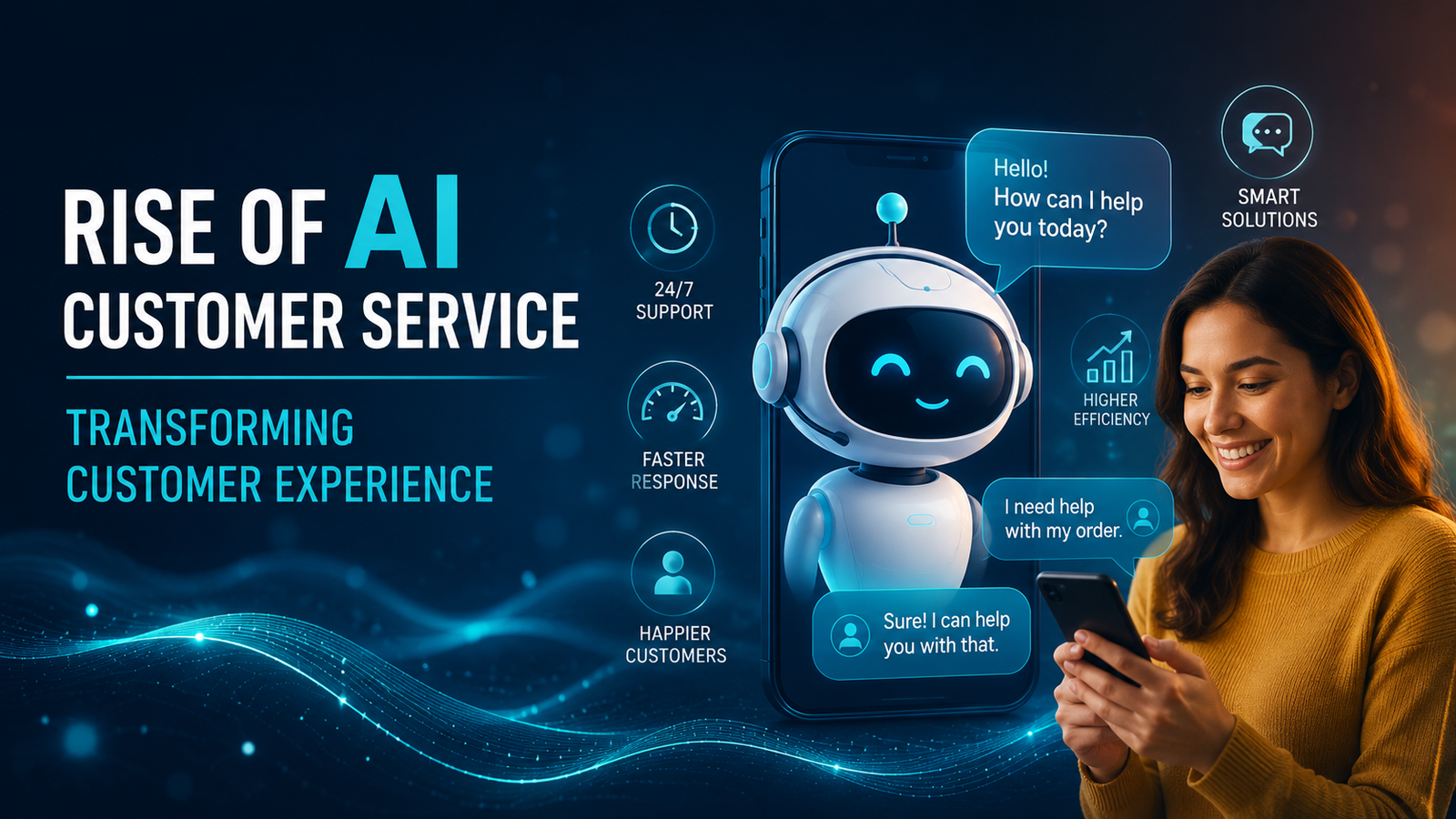
Transforming Customer Experience
Artificial intelligence is rapidly changing how businesses interact with customers. From answering routine questions to resolving complex issues, AI customer service solutions are becoming a critical part of modern business operations.
Organizations across industries are investing in AI chatbot technologies to improve customer experience, reduce support costs, and provide faster service. As customer expectations continue to rise, businesses are turning to AI-powered solutions to deliver support that is available 24/7, personalized, and scalable.
The shift is no longer limited to large enterprises. Small businesses, startups, and digital-first brands are also adopting AI tools to remain competitive in an increasingly customer-centric market.
The Growing Importance of AI Customer Service
Customer service has traditionally relied on human agents handling inquiries through phone calls, emails, and live chat. While effective, these methods often face challenges such as:
- Long wait times
- High operational costs
- Limited availability
- Inconsistent service quality
- Difficulty managing large volumes of requests
AI customer service addresses these challenges through intelligent automation and data-driven decision-making.
According to industry reports, customer expectations for instant support continue to increase, with many consumers expecting responses within minutes rather than hours. This demand has accelerated AI adoption across customer support departments worldwide.
What Is AI Customer Service?
AI customer service refers to the use of artificial intelligence technologies to assist, automate, and enhance customer support interactions.
These systems leverage:
- Natural Language Processing (NLP)
- Machine Learning
- Predictive Analytics
- Conversational AI
- Generative AI
The goal is simple: provide faster, more accurate, and personalized support while improving operational efficiency.
Common AI Customer Service Tools
| Technology | Primary Function | Business Benefit |
| AI Chatbot | Automated conversations | Faster response times |
| Virtual Assistant | Complex task handling | Improved self-service |
| Voice AI | Automated phone support | Reduced call center workload |
| Sentiment Analysis | Customer emotion detection | Better issue prioritization |
| Predictive Analytics | Forecast customer needs | Proactive support |
Why Businesses Are Investing in AI Customer Service
The business case for AI-powered support has become increasingly compelling.
1. 24/7 Customer Availability
Unlike human teams, AI systems operate continuously without breaks.
Customers can receive support at any time, regardless of location or time zone.
This is especially important for:
- E-commerce businesses
- SaaS companies
- Global brands
- Online service providers
2. Faster Response Times
Modern AI chatbot solutions can instantly respond to thousands of customer inquiries simultaneously.
Instead of waiting in queues, customers receive immediate answers for common issues such as:
- Order tracking
- Account access
- Billing questions
- Product information
3. Cost Efficiency
Customer support can represent a significant operational expense.
AI helps reduce costs by:
- Automating repetitive inquiries
- Reducing ticket volumes
- Improving agent productivity
- Lowering staffing requirements for routine tasks
Many organizations report substantial savings after implementing AI-powered support systems.
4. Improved Customer Experience
Today’s consumers value convenience and speed.
AI-driven support provides:
- Instant responses
- Personalized recommendations
- Consistent service quality
- Faster issue resolution
When implemented correctly, AI can significantly improve customer satisfaction scores.
The Rise of AI Chatbots
Among all customer service technologies, AI chatbots have experienced the fastest growth. Early chatbots followed simple scripted workflows and often frustrated users. Modern AI chatbot systems are far more sophisticated.
Powered by large language models and advanced NLP, today’s chatbots can:
- Understand natural language
- Interpret customer intent
- Maintain conversation context
- Generate human-like responses
- Escalate complex issues to human agents
Real-World Examples
Several major companies have integrated AI-powered customer support into their operations.
E-commerce
Online retailers use AI chatbots to:
- Track orders
- Recommend products
- Process returns
- Handle customer inquiries
Banking
Financial institutions deploy AI systems for:
- Account assistance
- Fraud alerts
- Loan information
- Transaction support
Telecommunications
Telecom providers leverage AI for:
- Technical troubleshooting
- Service activation
- Billing inquiries
- Network issue reporting
These applications improve customer experience while reducing support workloads.
How AI Is Personalizing Customer Experience
Personalization has become one of the most important factors in customer engagement.
AI enables businesses to analyze vast amounts of customer data and deliver tailored interactions.
AI-Powered Personalization Includes:
- Product recommendations
- Customized support responses
- Personalized offers
- Behavior-based engagement
- Predictive assistance
For example, an AI system can identify a customer’s purchase history and proactively suggest solutions before the customer contacts support.
This creates a more seamless and satisfying customer journey.
AI and Human Agents: A Collaborative Future
One common misconception is that AI will replace customer service teams entirely.
The reality is more balanced.
The most successful organizations use AI to augment human capabilities rather than replace them.
Tasks Best Suited for AI
- Frequently asked questions
- Order status updates
- Appointment scheduling
- Password resets
- Basic troubleshooting
Tasks Best Suited for Humans
- Complex problem-solving
- Emotional conversations
- Complaint resolution
- Negotiations
- Strategic customer relationships
This hybrid model combines efficiency with empathy.
Emerging Trends in AI Customer Service
Several technology trends are shaping the next generation of customer support.
Generative AI Integration
Generative AI is making customer interactions more natural and context-aware.
Instead of providing pre-written responses, AI systems generate dynamic answers tailored to each conversation.
Voice-Based AI Assistants
Voice AI is becoming increasingly accurate and capable.
Businesses are integrating conversational voice systems into call centers to improve response times and reduce wait periods.
Predictive Customer Support
Rather than reacting to problems, AI is helping companies anticipate issues before they occur.
Examples include:
- Predicting subscription cancellations
- Identifying service disruptions
- Detecting customer frustration
- Forecasting support demand
Omnichannel Customer Service
Customers expect seamless interactions across:
- Websites
- Mobile apps
- Social media
- Messaging platforms
AI helps unify these channels into a consistent customer experience.
Challenges and Risks of AI Customer Service
Despite its advantages, AI implementation presents challenges.
Data Privacy Concerns
Businesses must ensure customer data remains secure and compliant with regulations.
Organizations should maintain transparent data practices and robust cybersecurity measures.
Accuracy Issues
AI systems can occasionally generate incorrect responses.
Regular monitoring and human oversight remain essential.
Lack of Human Empathy
Some situations require emotional intelligence that AI cannot fully replicate.
Businesses must maintain easy access to human support when needed.
Implementation Costs
While AI can reduce long-term expenses, initial investments may include:
- Software licensing
- Integration costs
- Employee training
- Data management infrastructure
Best Practices for Businesses Adopting AI Customer Service
Organizations planning to implement AI should follow a structured approach.
Step 1: Identify Repetitive Tasks
Start by automating high-volume, repetitive inquiries.
Step 2: Maintain Human Escalation Paths
Customers should always have access to a human representative when required.
Step 3: Continuously Train AI Models
AI performance improves through ongoing learning and optimization.
Step 4: Monitor Performance Metrics
Track:
- Response times
- Resolution rates
- Customer satisfaction
- Escalation frequency
- Cost savings
Step 5: Focus on Customer Experience
Technology should support customer needs rather than create barriers.
Businesses that prioritize customer experience typically achieve stronger adoption and better outcomes.
Key Takeaways
- AI customer service is becoming a core business strategy.
- AI chatbot technology improves response speed and operational efficiency.
- Personalized interactions enhance customer experience.
- Human agents remain essential for complex and sensitive situations.
- Generative AI and predictive support are shaping the future of customer service.
- Businesses adopting AI strategically gain a competitive advantage.
Future Outlook
The future of customer service will be increasingly intelligent, personalized, and proactive.
Advancements in generative AI, machine learning, and conversational technology will continue to improve how businesses engage with customers. Over the next few years, AI systems are expected to handle a larger share of routine interactions while empowering human agents to focus on higher-value conversations.
Organizations that invest in AI customer service today will be better positioned to meet rising customer expectations, improve operational efficiency, and build stronger customer relationships.
Success will depend on balancing automation with human expertise. Companies that combine AI efficiency with human empathy are likely to deliver the best customer experience and achieve sustainable growth.
FAQs
1. What is AI customer service?
AI customer service uses artificial intelligence technologies such as machine learning, natural language processing, and automation to assist customers, answer questions, and resolve issues more efficiently.
2. How does an AI chatbot improve customer support?
An AI chatbot provides instant responses, handles repetitive inquiries, operates 24/7, and reduces customer wait times, leading to a better customer experience.
3. Can AI completely replace human customer service agents?
No. AI is best suited for routine tasks, while human agents remain essential for complex issues, emotional conversations, and relationship management.
4. What industries benefit most from AI customer service?
Industries such as e-commerce, banking, healthcare, telecommunications, travel, and SaaS benefit significantly from AI-powered customer support solutions.
5. What are the biggest challenges of AI customer service?
Common challenges include data privacy concerns, response accuracy, implementation costs, integration complexity, and maintaining a balance between automation and human interaction.