

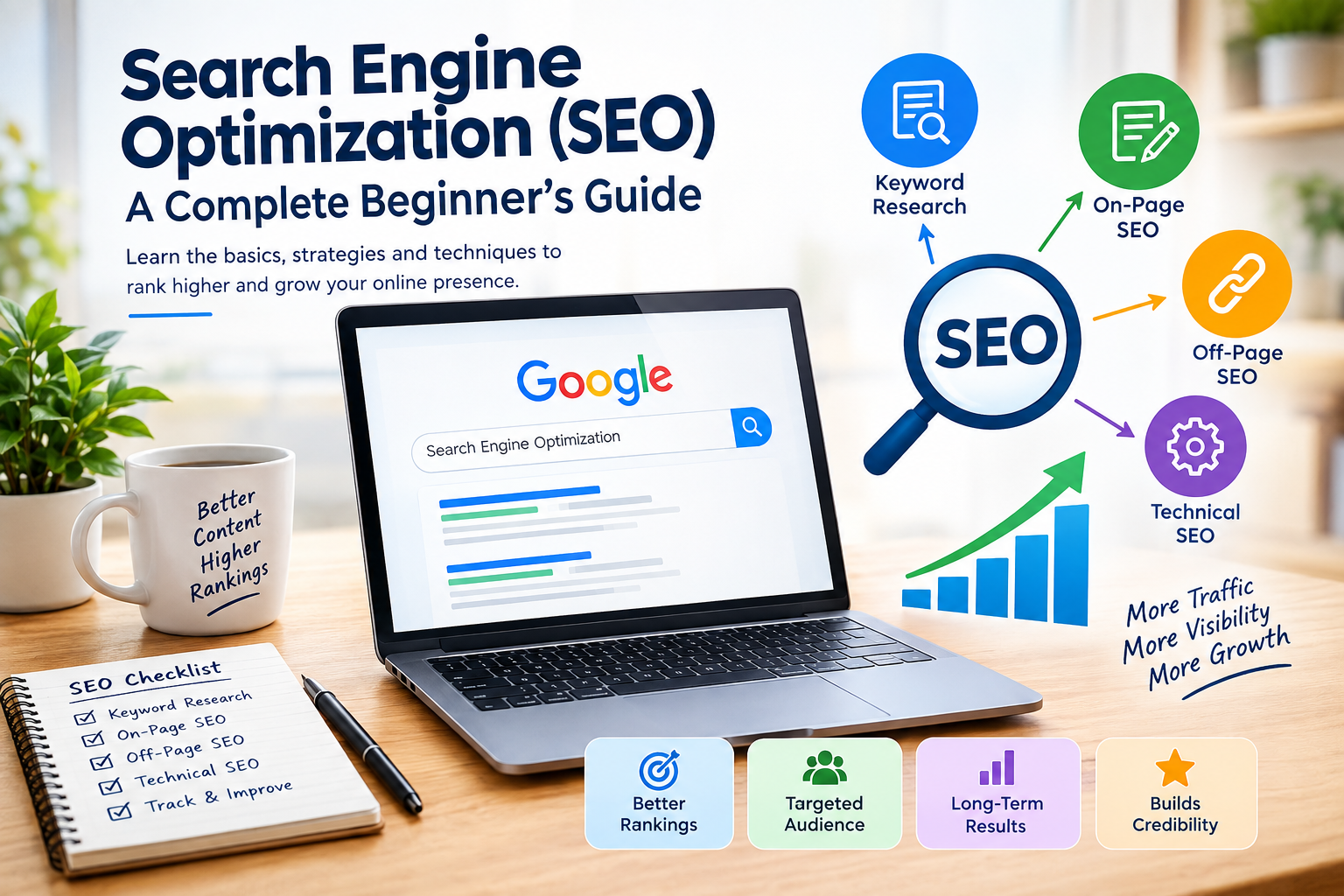
Search Engine Optimization (SEO) A Complete Beginner’s Guide
Search Engine Optimization, commonly known as SEO, is the process of improving a website so that its pages can appear more prominently in search engine results. When people search for information, products, services, or solutions on Google, SEO helps a website become easier for search engines to understand and users to discover.
For beginners, SEO can seem complicated because it includes keywords, content, links, technical improvements, website structure, and many other factors. However, the basic idea is simple: create useful content, make your website easy to understand, and provide a good experience for visitors.
This guide explains the fundamentals of Search Engine Optimization, including SEO strategy, on-page SEO, off-page SEO, technical SEO, keyword research, common mistakes, and practical steps beginners can follow.
What Is Search Engine Optimization?
Search Engine Optimization is a digital marketing practice used to improve a website’s visibility in organic search results.
Organic traffic is different from paid advertising. With paid search, businesses pay for advertisements to appear in search results. With SEO, the goal is to earn visibility through relevant content, website quality, authority, and technical optimization.
For example, imagine someone searches:
“best HRMS software for small businesses”
An HR software company can create a useful page that explains HRMS features, benefits, pricing considerations, and selection tips. By optimizing the page around the user’s search intent, the website has an opportunity to attract relevant visitors.
Why Is SEO Important for a Website?
A good SEO strategy can help businesses attract people who are already searching for information related to their products or services.
Some important benefits include:
- Increased organic website traffic
- Better search visibility
- More relevant visitors
- Improved brand awareness
- Greater credibility and authority
- Potentially more leads and customers
- Long-term digital marketing benefits
SEO is particularly valuable for businesses because it can target users at different stages of the buying journey.
For example:
Informational search:
“What is payroll software?”
Commercial search:
“Best payroll software for small business”
Transactional search:
“Buy payroll software”
Each search represents a different user need, so the content should match the search intent.
How Does SEO Work?
Search engines discover, crawl, understand, and organize web pages before deciding which pages are most relevant to a particular search.
Although search algorithms are complex, beginners can focus on three broad areas:
- Relevance – Does the page answer the user’s query?
- Quality – Is the information useful, reliable, and well presented?
- Website experience – Can users and search engines access and navigate the page easily?
This is why SEO is not simply about inserting a keyword repeatedly into an article.
A successful website combines useful content, proper optimization, technical accessibility, and a strong overall user experience.
Key Types of SEO
SEO can be divided into several major areas. The three most important categories for beginners are on-page SEO, off-page SEO, and technical SEO.
1. On-Page SEO
On-page SEO involves optimizing elements that exist on your website or individual webpage.
Important elements include:
Keyword Optimization
Keywords are words or phrases that people use when searching online.
For example:
- Search Engine Optimization
- SEO strategy
- SEO techniques
- on-page SEO
- technical SEO
Keywords should be included naturally where relevant rather than repeated excessively.
Title Tag
The title helps search engines and users understand what a webpage is about.
For example:
Search Engine Optimization: Complete Beginner’s Guide
A clear title can improve relevance and encourage users to click on the result.
Meta Description
A meta description briefly describes the webpage in search results.
It should clearly communicate what readers will learn and encourage relevant users to visit the page.
Headings
Use H1, H2, and H3 headings to organize content.
For example:
- H1: Search Engine Optimization: Complete Beginner’s Guide
- H2: What Is Search Engine Optimization?
- H2: Why Is SEO Important?
- H2: Key Types of SEO
- H3: On-Page SEO
A clear structure makes longer content easier to read.
Internal Links
Internal links connect one page of your website to another relevant page on the same website.
For example, an article about SEO can link naturally to another article about keyword research.
Internal linking helps users discover related content and helps search engines understand the relationship between pages.
2. Off-Page SEO
Off-page SEO refers to activities performed outside your own website to build authority and reputation.
One important part is earning links from other relevant and trustworthy websites.
Other activities may include:
- Digital PR
- Brand mentions
- Guest posting
- Relevant backlinks
- Industry relationships
- Content promotion
However, the focus should be on quality and relevance rather than collecting a large number of low-quality links.
A backlink from a relevant, trustworthy website can be more valuable than many unrelated links.
3. Technical SEO
Technical SEO focuses on making a website easier for search engines to crawl, understand, and access.
Important areas include:
- Website speed
- Mobile usability
- XML sitemap
- Robots.txt
- HTTPS
- Proper URL structure
- Canonical URLs
- Crawlability
- Indexing
- Core Web Vitals
- Structured data where appropriate
For example, if an important page cannot be crawled or indexed, even excellent content may struggle to receive organic search visibility.
Keyword Research in SEO
Keyword research is one of the first steps in developing an effective SEO strategy.
The objective is not simply to find keywords with the highest search volume. You should also consider:
- Search intent
- Search volume
- Keyword difficulty
- Competition
- Relevance
- Business value
Short-Tail vs Long-Tail Keywords
| Type | Example | General Character |
| Short-tail | SEO | Broad and competitive |
| Medium-tail | SEO techniques | More specific |
| Long-tail | SEO techniques for small businesses | Highly specific |
Long-tail keywords often have lower search volume, but they can be valuable because they may represent a more specific user need.
For example, someone searching for “SEO” may only want a definition. Someone searching for “SEO agency for small business” may have a much stronger commercial intent.
Understanding Search Intent
Search intent means understanding why someone is performing a search.
Common types include:
Informational Intent
The user wants information.
Example:
What is technical SEO?
Commercial Investigation
The user is researching options.
Example:
Best SEO tools for small businesses
Transactional Intent
The user is ready to take an action.
Example:
Buy SEO software
Navigational Intent
The user is looking for a specific website or brand.
Example:
Google Search Console login
Matching content with search intent is an important part of a successful SEO strategy.
How to Create an Effective SEO Strategy
A practical SEO strategy can follow these steps:
Step 1: Understand Your Audience
Identify who you want to reach and what problems they are trying to solve.
Step 2: Research Relevant Keywords
Use keyword research tools and search suggestions to identify topics your audience is actually searching for.
Step 3: Analyze Search Intent
Look at the type of content already appearing for your target query and determine what users expect.
Step 4: Create Useful Content
Answer the user’s questions clearly and provide information that is genuinely useful.
Step 5: Optimize the Page
Work on the title, headings, URL, content structure, images, internal links, and other relevant on-page elements.
Step 6: Improve Technical SEO
Make sure search engines can crawl and index your important pages properly.
Step 7: Build Authority
Promote valuable content and earn relevant mentions and backlinks.
Step 8: Measure Performance
Monitor organic traffic, rankings, clicks, impressions, conversions, and indexing through appropriate SEO and analytics tools.
Common SEO Mistakes Beginners Should Avoid
Many beginners focus too heavily on keywords and forget the actual reader.
Avoid these mistakes:
- Keyword stuffing
- Copying content from other websites
- Creating very thin content
- Using irrelevant backlinks
- Ignoring mobile users
- Publishing without understanding search intent
- Using misleading titles
- Ignoring technical SEO
- Creating pages that provide little additional value
- Expecting immediate results
SEO generally requires consistent effort. A website may need time to build visibility, authority, and trust.
SEO Trends Businesses Should Watch
Search continues to evolve as users interact with traditional search results, AI-powered search experiences, visual search, voice interfaces, and other discovery systems.
This makes it increasingly important to create content that is:
- Original
- Helpful
- Well structured
- Easy to understand
- Based on reliable information
- Written for real users
Businesses should also pay attention to first-hand experience, expertise, author credibility, and trustworthiness when publishing important content.
For Indian businesses, SEO also provides an opportunity to reach users searching for products and services in specific cities, regions, and languages. Local SEO, mobile-friendly experiences, and useful location-specific content can therefore be important parts of a broader digital marketing strategy.
SEO Tools Beginners Can Use
Beginners do not need dozens of tools. A small set of reliable tools can provide useful insights.
Common options include:
- Google Search Console – search performance and indexing information
- Google Analytics – website traffic and user behavior
- Google Trends – search interest and trends
- Keyword research platforms – keyword opportunities and competition
- SEO auditing tools – technical and on-page checks
The important thing is not simply using a tool. The data needs to be interpreted and converted into practical improvements.
How Long Does SEO Take to Show Results?
There is no fixed timeline for SEO.
Results can depend on:
- Website age
- Competition
- Industry
- Content quality
- Technical condition
- Website authority
- Backlink profile
- Search demand
- Consistency of SEO work
Instead of expecting instant rankings, businesses should monitor progress through measurable indicators such as impressions, clicks, rankings, organic traffic, leads, and conversions.
SEO vs Paid Search
| SEO | Paid Search |
| Organic visibility | Paid visibility |
| No payment for every organic click | Advertisers generally pay for clicks/impressions |
| Can provide long-term value | Traffic can stop when campaigns stop |
| Requires content and optimization | Requires advertising budget |
| Usually takes time to build | Can generate visibility quickly |
The two approaches do not have to compete. Many businesses use both SEO and paid search as part of their digital marketing strategy.
Beginner SEO Checklist
Before publishing a webpage, check the following:
- Target keyword identified
- Search intent understood
- SEO-friendly title created
- Clear H1 heading used
- Useful H2/H3 structure added
- Keyword used naturally
- Meta description written
- Short, readable URL created
- Relevant internal links added
- Useful external sources linked where appropriate
- Images optimized with descriptive alt text
- Mobile experience checked
- Page is crawlable and indexable
- Content provides genuine value
Future of Search Engine Optimization
The future of Search Engine Optimization will continue to move beyond traditional keyword rankings.
Search engines are becoming better at understanding context, intent, entities, relationships, and natural language. At the same time, users are discovering information through multiple search and AI-powered experiences.
For businesses, this means SEO should not be treated as a one-time task.
A stronger long-term approach is to consistently publish useful content, improve existing pages, strengthen technical foundations, understand audience needs, and build genuine authority in the industry.
FAQs
1. What is Search Engine Optimization?
Search Engine Optimization is the process of improving a website and its content to increase its visibility in organic search engine results.
2. What are the main types of SEO?
The main areas are on-page SEO, off-page SEO, and technical SEO. Local SEO and specialized SEO practices can also be used depending on the website and business.
3. Is SEO important for small businesses?
Yes. SEO can help small businesses reach people who are actively searching for their products, services, or information online.
4. What is the difference between SEO and SEM?
SEO focuses primarily on earning organic search visibility, while SEM is commonly used as a broader term for search engine marketing that can include paid search advertising.
5. How can beginners learn SEO?
Beginners should start with keyword research, search intent, on-page SEO, technical SEO, internal linking, content creation, and performance measurement. Practicing these skills on real websites is one of the best ways to learn.
Conclusion
Search Engine Optimization is not just about adding keywords to a webpage. It is a complete process that combines useful content, search intent, on-page SEO, off-page SEO, technical SEO, website experience, and authority building.
For beginners, the best approach is to start with the fundamentals. Understand your audience, research relevant keywords, create genuinely useful content, optimize your pages, maintain a technically healthy website, and regularly measure your results.
As search continues to evolve, websites that focus on helpful content, trust, relevance, and user experience will be better positioned for long-term organic growth.