

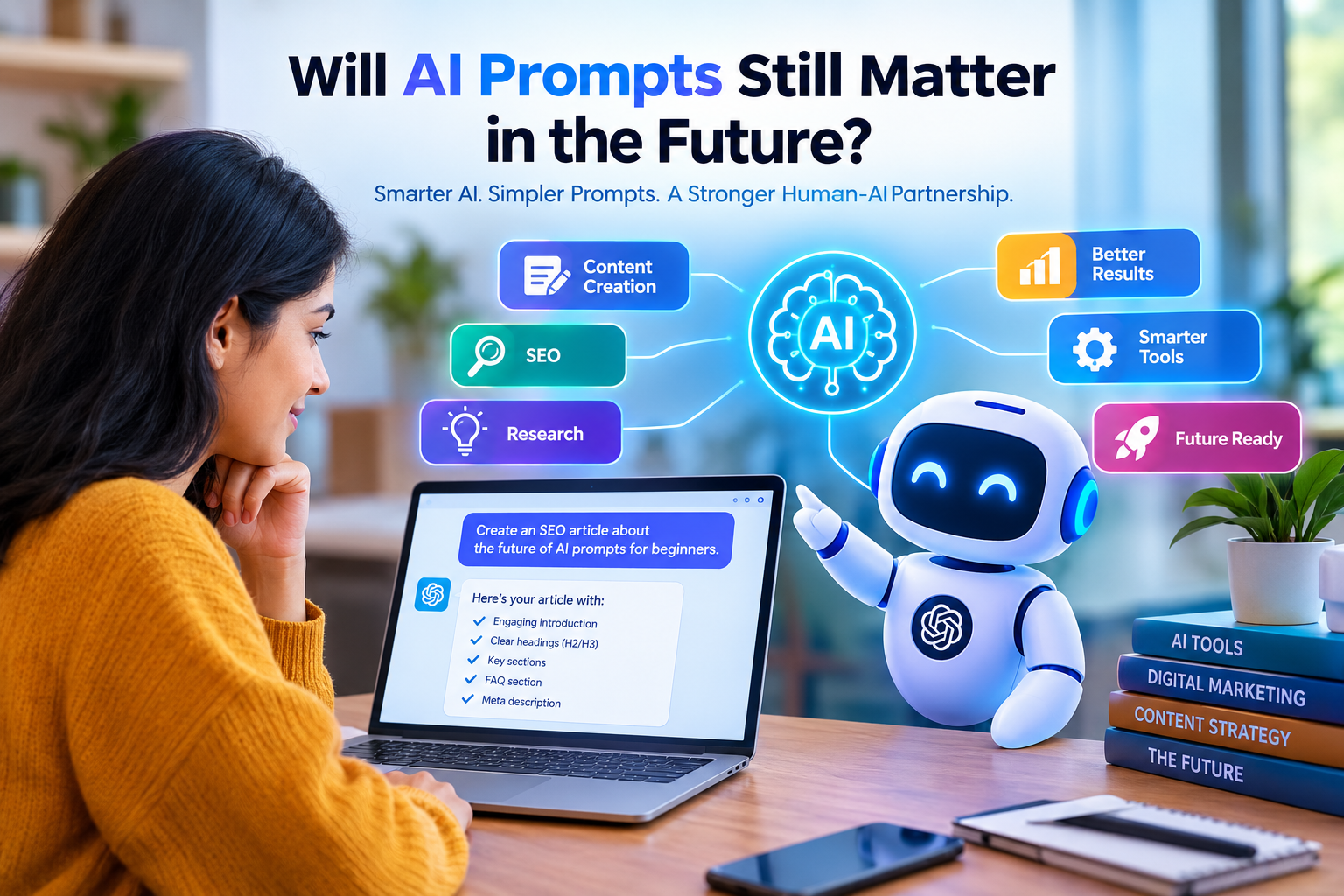
Artificial intelligence is changing how people work, search for information, create content, analyze data, and solve everyday problems. As AI tools become more capable, one question is becoming increasingly important:will AI prompts still matter in the future?
Today, users often need to give an AI tool clear instructions to receive useful results. A well-written prompt can explain the task, provide context, define the desired format, and guide the AI toward a better response.
However, AI technology is developing quickly. Modern AI systems are becoming better at understanding natural language, context, user preferences, and complex tasks. This raises an important question about the future role of prompts.
Will people still need to learn detailed prompt writing, or will AI become smart enough to understand what users want automatically?
What Are AI Prompts?
An AI prompt is an instruction, question, or description given to an artificial intelligence system.
For example, a simple prompt could be:
Write a 500-word article about digital marketing for beginners.
A more detailed prompt could specify the audience, tone, structure, keywords, word count, and purpose.
The quality of the instruction can influence the usefulness of the AI’s response.
Why Are AI Prompts Important Today?
AI tools are powerful, but users still need to communicate their goals clearly.
Effective prompts can help users:
- Explain what they want
- Provide useful background information
- Define the desired output
- Control tone and writing style
- Request specific formats
- Reduce unnecessary information
- Improve the relevance of AI-generated responses
For content creators and digital marketers, prompts can make repetitive tasks faster and easier.
How AI Prompt Writing Is Changing
In the early stages of generative AI, users often had to learn specific prompting techniques to get useful results.
They experimented with detailed instructions, examples, formatting requirements, roles, and step-by-step tasks.
Today, AI systems are becoming more conversational.
Users can often explain what they need in ordinary language rather than creating complicated instructions.
This means the future of AI prompt writing may not be about memorizing complicated formulas. Instead, it may focus more on communicating goals clearly.
Will Prompt Engineering Disappear?
Probably not—but its role may change.
As AI systems become more capable, some basic prompting tasks may become less important.
For example, users may not need to carefully structure every simple request. AI systems may increasingly understand context from previous interactions and automatically ask questions when important information is missing.
However, complex tasks will still require users to communicate objectives, constraints, priorities, and expected results.
Therefore, prompt engineering may evolve rather than completely disappear.
The Future of AI Prompts
The future is likely to involve a combination of natural-language communication and more advanced AI systems.
1. Simpler Prompts
People may be able to describe their goal in a few sentences and let the AI determine the best way to complete the task.
Instead of writing:
Create a detailed SEO article with H2 headings, FAQs, meta description, keyword placement, and a conclusion.
A user may simply say:
Create an SEO article about the future of AI prompts for beginners.
The AI could understand the expected structure based on the context.
2. AI Will Ask Better Questions
Future AI systems may not simply respond immediately.
They may identify missing information and ask:
- Who is the target audience?
- What is the purpose?
- What format do you need?
- What tone should be used?
- What limitations should be followed?
This could reduce the need for users to write extremely detailed prompts.
3. More Personalized AI
AI systems are increasingly designed to understand user preferences and ongoing tasks.
As personalization improves, users may not need to repeat the same instructions every time.
For example, a content writer could establish a preferred writing style once and then simply provide the topic.
The AI could use the established preferences when generating future content.
AI Prompts and Content Creation
Content creation is one area where prompts are likely to remain useful.
Writers can use AI to help with:
- Topic research
- Content outlines
- Headline ideas
- Draft creation
- Content rewriting
- Summaries
- FAQs
- Social media content
- Content optimization
However, human review remains important.
AI-generated content can contain inaccurate information, outdated claims, repetitive wording, or content that does not properly match the audience.
The best workflow is therefore not simply prompt → publish.
A stronger process is:
Prompt → AI output → Human review → Editing → Fact-checking → Final publication
AI Prompts and SEO
SEO professionals can also use AI prompts for a variety of tasks.
For example, prompts can help generate:
- Keyword research ideas
- Search intent categories
- Content outlines
- Title variations
- Meta descriptions
- FAQ ideas
- Internal linking suggestions
- Content briefs
But AI should support an SEO strategy rather than replace SEO knowledge.
Search intent, audience needs, website authority, competition, content quality, and technical SEO still need human judgment.
Will People Still Need Prompt Engineering Skills?
Yes, but the required skills may change.
Instead of focusing only on complicated prompt structures, users may benefit more from learning how to:
- Explain a problem clearly.
- Give relevant context.
- Define the expected result.
- Set important limitations.
- Review the AI’s response.
- Ask useful follow-up questions.
- Verify important information.
In other words, the future of prompting may be less about writing the perfect prompt and more about communicating effectively with AI.
AI Tools and the Changing User Experience
AI tools are becoming easier to use.
Many platforms now allow people to interact with AI through normal conversations instead of technical commands.
This could make AI accessible to people who have never studied prompt engineering.
For businesses, this may mean employees will increasingly use AI as a normal workplace tool rather than treating it as a specialized technology.
Challenges of Depending Too Much on AI Prompts
Although AI prompts are useful, users should avoid depending on them blindly.
Accuracy
AI can produce incorrect information.
Important claims should be verified before publication or business use.
Originality
Generating content with the same generic instructions can produce repetitive results.
Adding unique experience, examples, opinions, and useful data can make content more valuable.
Context
AI may misunderstand a short or ambiguous instruction.
Providing the necessary context can improve the result.
Human Judgment
AI can generate information, but users still need to decide whether the information is appropriate, accurate, and useful.
How to Prepare for the Future
People who want to stay competitive should learn both AI usage and human skills.
Focus on these areas:
- Clear communication
- Critical thinking
- Fact-checking
- Research
- Content strategy
- Data interpretation
- AI tool knowledge
- Problem solving
Learning how to write good prompts is useful, but understanding why a particular instruction works is even more valuable.
What Will AI Prompting Look Like in the Future?
The future may move from traditional prompt writing toward AI collaboration.
Instead of creating one perfect instruction, users may have ongoing conversations with AI.
The process could look like this:
Goal → AI questions → User clarification → AI execution → Human feedback → Improved result
This approach can make AI interaction more natural and efficient.
Prompting may therefore become less like programming and more like managing a digital assistant.
FAQs
1. Will AI prompts still be important in the future?
Yes. Simple prompts may become shorter, but clear instructions, context, goals, and constraints will remain useful for complex tasks.
2. Will prompt engineering disappear?
Prompt engineering is more likely to evolve than disappear. As AI becomes easier to use, the focus may shift from technical prompt structures toward effective AI communication.
3. Do beginners need to learn prompt engineering?
Beginners can benefit from learning basic prompting skills, but they do not necessarily need advanced techniques for everyday AI tasks.
4. Can AI replace human content writers?
AI can assist with many writing tasks, but human expertise remains important for research, fact-checking, originality, strategy, and understanding the audience.
5. What is the most important AI skill for the future?
The ability to communicate clearly with AI, evaluate its output, verify information, and apply human judgment will be increasingly valuable.
Conclusion
AI technology is moving toward more natural and intelligent interaction. As this happens, traditional prompt-writing techniques may become simpler, but the ability to communicate goals and evaluate AI responses will remain valuable.
The future is unlikely to be about humans writing increasingly complicated prompts. Instead, it will be about humans and AI working together more effectively.
For anyone working with content, SEO, marketing, education, or business, learning how to use AI prompts today can provide a useful foundation for adapting to the AI-powered tools of tomorrow.