

Introduction
The way people use search engines has changed significantly. Earlier, a typical search journey involved entering a query, scanning the results and clicking a website to find an answer.
That process is no longer always necessary.
Google can now provide information directly within the search results through featured snippets, knowledge panels, local results, images, videos and AI-powered search experiences. Users can sometimes get what they need without visiting a traditional webpage.
This behavior is known as Zero-Click Search.
For website owners and SEO professionals, this creates an important question: if users don’t click, what happens to SEO?
The answer is not that SEO is becoming irrelevant. Instead, SEO is moving beyond simply generating clicks. Search visibility, brand exposure, content authority and qualified traffic are becoming increasingly important parts of the overall strategy.
What Is Zero-Click Search?
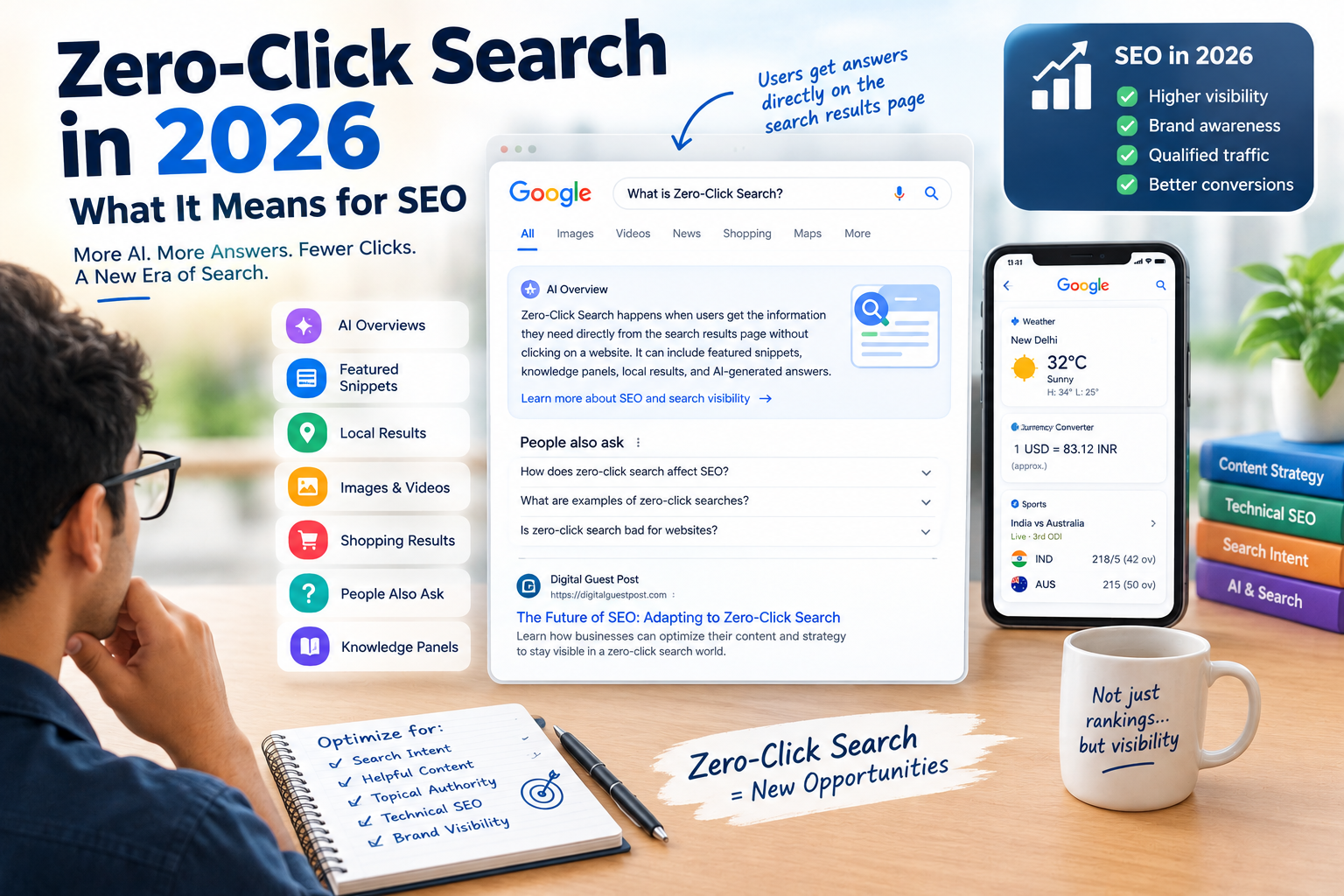
Zero-Click Search refers to a search where the user gets the required information directly from the search results without clicking an organic result.
For example, a person might search:
“What is SEO?”
If Google displays a direct answer at the top of the page, the user may not need to visit another website.
Zero-click results can appear through different search features, including:
- Featured snippets
- Knowledge panels
- Local search information
- Weather results
- Currency conversions
- Sports scores
- Product information
- People Also Ask
- AI-generated search answers
The important distinction is that zero-click does not necessarily mean zero visibility.
A business can still appear in front of potential customers even when the search does not produce a website visit.
Why Is Zero-Click Search Important in 2026?
Search results have become much more sophisticated.
Google is no longer simply showing a list of webpages. It is increasingly trying to understand the user’s question and provide useful information directly within the search experience.
AI Is Changing Search Behavior
AI-powered search experiences can summarize information and help users explore complicated topics without requiring them to open several individual websites.
Google’s current documentation confirms that AI features are now part of the Search experience, while established SEO fundamentals continue to matter for visibility in these AI-powered experiences.
This means SEO professionals should not abandon traditional SEO.
Instead, they should adapt traditional SEO to a more complex search environment.
How Zero-Click Search Affects Organic Traffic
One of the biggest concerns for website owners is traffic.
If someone gets an answer directly from Google, they may not click the website that supplied or influenced that information.
This can be particularly important for simple informational searches.
For example:
“What is digital marketing?”
may be answered directly.
But a query such as:
“Best digital marketing agency for a small business”
usually requires more research.
The user may compare:
- Services
- Pricing
- Reviews
- Experience
- Case studies
- Companies
- Contact information
Therefore, not every search is equally vulnerable to zero-click behavior.
Understanding search intent is essential.
Search Intent Becomes More Important
A strong SEO strategy in 2026 should consider what the user wants to accomplish.
Informational Intent
The user wants an answer.
Examples:
- What is SEO?
- What is zero-click search?
- How does SEO work?
These searches can have a higher chance of being answered directly in Search.
Commercial Investigation
The user is researching options.
Examples:
- Best HRMS software for small businesses
- Best SEO tools for agencies
- SEO software comparison
These searches can create stronger opportunities for website visits.
Transactional Intent
The user is ready to take action.
Examples:
- Buy HRMS software
- Hire an SEO agency
- Get payroll software demo
These searches are particularly valuable for businesses because the user has a stronger commercial intent.
Navigational Intent
The user is looking for a specific brand or website.
Examples:
- Digital Guest Post
- Google Search Console
- HR Niti login
Understanding these differences helps businesses prioritize the right keywords and pages.
Zero-Click Search vs Traditional SEO
| Traditional SEO | Modern SEO |
| Focus on keyword rankings | Focus on overall search visibility |
| Organic traffic is a major KPI | Traffic + visibility + conversions |
| Mainly optimize blue links | Optimize the complete search presence |
| Focus on clicks | Focus on clicks and brand exposure |
| Keyword-focused content | Intent and topic-focused content |
| SERP rankings | SERPs + AI search experiences |
This does not mean rankings are no longer important.
They are.
The difference is that rankings are now one part of a larger SEO picture.
How to Optimize for Zero-Click Search
1. Answer Questions Directly
If your article targets a specific question, provide a clear answer early in the content.
For example:
What is Zero-Click Search?
A good answer should immediately explain the concept before moving into detailed analysis.
This improves usability and makes the page easier to understand.
2. Use Clear Content Structure
Well-organized content is easier for users to read and easier for search engines to interpret.
Use:
- One clear H1
- Relevant H2 headings
- H3 subheadings
- Short paragraphs
- Bullet points
- Tables
- Examples
- FAQs
Avoid creating large blocks of text that make important information difficult to find.
3. Focus on Long-Tail Keywords
Long-tail searches often provide more information about what the user actually wants.
Instead of targeting only:
SEO
you can target:
how does zero-click search affect SEO
or:
how to improve website visibility in zero-click search results
These searches can provide clearer content opportunities.
4. Create Content That Offers More Than a Basic Answer
This is one of the most important strategies.
If your content provides exactly the same information that users can find everywhere else, it has limited differentiation.
Add:
- Original examples
- Expert insights
- Industry data
- Case studies
- Practical recommendations
- Comparisons
- First-hand experience
- Original research
The goal should be to create content that users cannot easily replace with a quick search answer.
5. Build Topical Authority
Don’t create one article about zero-click search and stop there.
Build a group of closely related articles.
For example:
- Zero-Click Search in 2026
- AI Overviews and SEO
- Search Intent in 2026
- AI Search Optimization
- SEO Content Strategy
- How Google Search Is Changing
- Technical SEO in 2026
Connect relevant articles through internal links.
This helps create a stronger topical relationship between your pages.
6. Strengthen Internal Linking
Internal links help users move from one useful article to another.
For example, if an article discusses SEO strategy, you can link to a detailed article about SEO strategy using a relevant anchor text.
Avoid using generic anchors such as:
Click here
Instead use descriptive phrases that tell the reader what they will find.
7. Keep Technical SEO Strong
Zero-click optimization does not replace technical SEO.
Your website still needs a strong technical foundation.
Important areas include:
- Mobile usability
- Page speed
- Crawlability
- Indexing
- HTTPS
- XML sitemap
- Internal links
- Canonical URLs
- Clean URL structure
- Structured data where appropriate
If search engines cannot properly access or understand your content, strong writing alone will not solve the problem.
AI Overviews and Zero-Click Search
AI Overviews have added another layer to the search experience.
Instead of only displaying traditional organic results, Google can provide an AI-generated overview that brings together information relevant to a user’s query.
For SEO professionals, the important lesson is simple:
Don’t create content specifically to “trick” AI systems.
Create content that is:
- Accurate
- Helpful
- Relevant
- Original
- Well structured
- Trustworthy
Google’s guidance continues to emphasize established SEO practices for its AI-powered Search experiences.
Does Zero-Click Search Mean SEO Is Dead?
Absolutely not.
SEO is changing, but it remains an important channel for discovery.
Consider a customer journey:
Search → Brand discovery → Research → Website visit → Comparison → Conversion
The first search may not generate a click.
But that doesn’t mean the search was worthless.
A user may remember the brand and search for it later.
This is why modern SEO should consider both direct traffic outcomes and broader brand visibility.
What Businesses Should Measure in 2026
SEO reporting should not rely entirely on keyword rankings.
Track multiple metrics.
Search Visibility
- Impressions
- Rankings
- SERP features
- Brand visibility
Website Performance
- Organic clicks
- CTR
- Organic sessions
- Engagement
Business Performance
- Leads
- Sign-ups
- Sales
- Revenue
- Conversion rate
The most important question is not:
“How many keywords are ranking?”
It is:
“Is organic search helping the business achieve its goals?”
Common Zero-Click SEO Mistakes
Keyword Stuffing
Repeating Zero-Click Search excessively does not make an article more relevant.
Use the focus keyword naturally.
Writing Generic Content
Publishing another article that repeats information already available everywhere provides little additional value.
Add unique insights and practical information.
Ignoring Search Intent
A page should match the reason behind the search.
Don’t turn every informational article into a sales page.
Focusing Only on Traffic
Traffic is important, but qualified traffic and conversions matter more than raw visitor numbers.
Ignoring Brand Visibility
SEO is increasingly connected to brand discovery.
A user may see your brand several times before becoming a customer.
A Practical Zero-Click SEO Strategy
Businesses can use the following process:
Step 1: Identify Important Topics
Find topics directly connected to your products, services and customers.
Step 2: Research Search Intent
Understand whether users want information, comparisons or a solution.
Step 3: Find Long-Tail Opportunities
Look for specific questions and problems your audience searches for.
Step 4: Create Useful Content
Provide a direct answer and then add deeper information.
Step 5: Add Original Value
Use examples, experience, data and practical recommendations.
Step 6: Improve On-Page SEO
Optimize headings, titles, descriptions, URLs and internal links.
Step 7: Improve Technical SEO
Make sure search engines can crawl, understand and index your content.
Step 8: Monitor Performance
Track rankings, impressions, CTR, traffic and conversions.
Step 9: Update Content
Search behavior changes. Review important content regularly.
What Is the Future of Zero-Click SEO?
Search will continue becoming more conversational and personalized.
Users will increasingly expect search engines to understand complete questions rather than isolated keywords.
That means SEO professionals need to think about:
- Topics instead of only keywords
- Search intent instead of only volume
- Visibility instead of only rankings
- Trust instead of only backlinks
- Business outcomes instead of only traffic
The brands that adapt early will have a stronger opportunity to remain visible as search evolves.
FAQs
What is Zero-Click Search?
Zero-Click Search occurs when a user receives the information they need directly from the search results without clicking a traditional organic result.
Is Zero-Click Search bad for SEO?
It can reduce clicks for certain searches, particularly simple informational queries. However, search visibility can still provide brand exposure and influence future searches.
How do AI Overviews affect SEO?
AI Overviews can provide answers directly within Google Search, changing how users interact with traditional results. Websites still need strong content and SEO fundamentals to compete for visibility.
How can I optimize my website for Zero-Click Search?
Focus on search intent, clear answers, useful content, strong content structure, topical authority and technical SEO.
Will SEO still be important in 2026?
Yes. SEO remains important, but successful strategies increasingly need to focus on overall search visibility, content quality, user intent and business results—not rankings alone.
Conclusion
Zero-Click Search is changing the way SEO professionals think about search visibility in 2026.
The traditional objective of ranking a page and generating a click is still valuable, but it is no longer the complete picture.
AI-powered search, featured results and other SERP features mean that users can discover information without visiting a website immediately.
For businesses, the right response is not to chase every new search feature or abandon traditional SEO.
Instead, build a strong foundation around search intent, helpful content, technical SEO, topical authority, original insights and brand trust.
The future of SEO is not simply about getting more clicks.
It is about being visible, useful and credible wherever your audience is searching.