

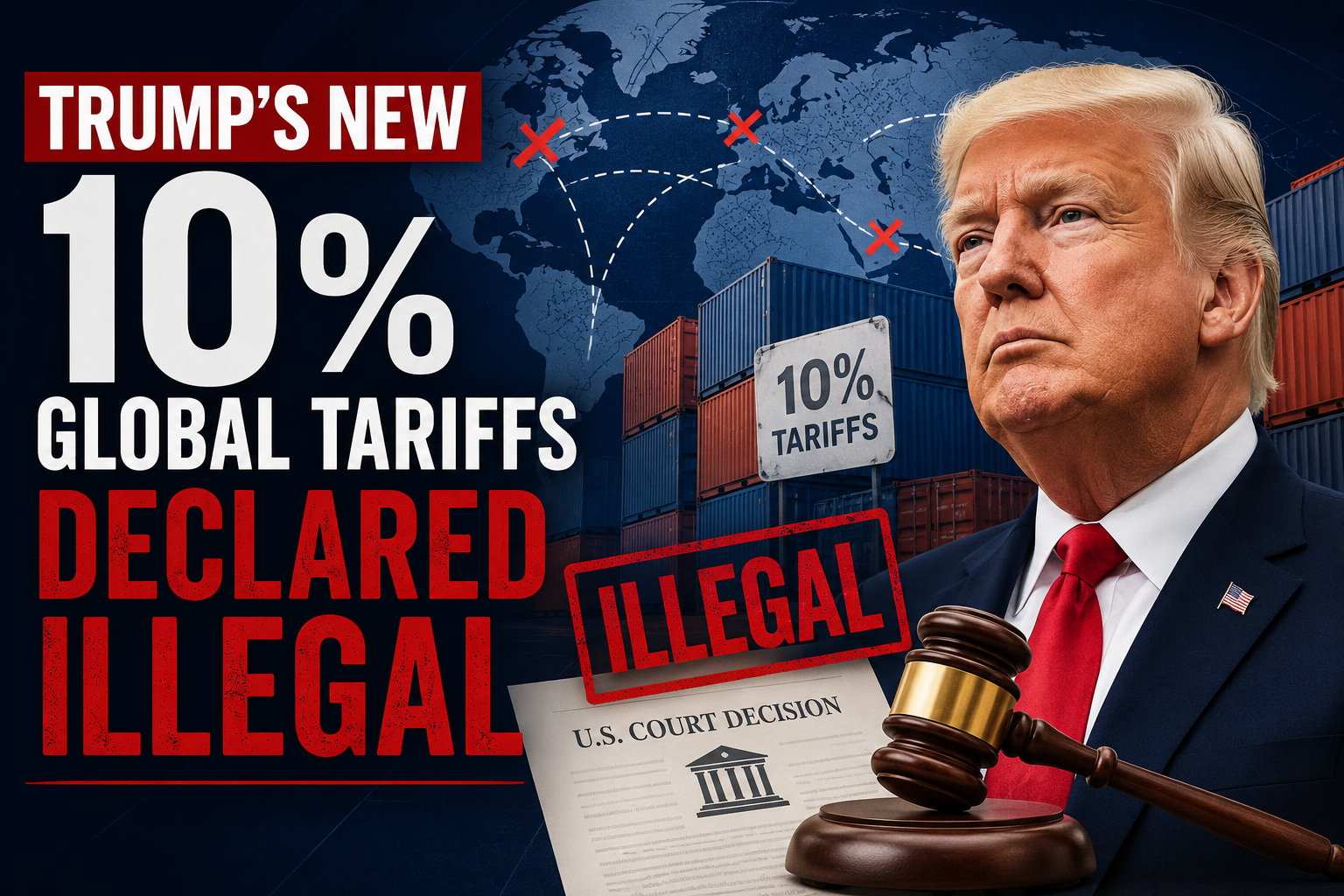
The global trade market is once again facing uncertainty after a US federal trade court ruled Donald Trump’s newly announced 10% global tariffs as “illegal.” The decision has created confusion across international markets, especially for countries like India that rely heavily on exports to the United States.
The ruling comes at a time when India-US trade relations are already under pressure due to ongoing negotiations on tariffs, manufacturing partnerships, and supply-chain diversification. According to the US Court of International Trade, Trump’s administration exceeded its authority while imposing the blanket tariffs under Section 122 of the Trade Act.
Although the court’s decision currently applies only to specific plaintiffs, economists believe the impact of this legal battle could reshape global trade strategies in 2026.
Why Were the Tariffs Introduced?
After the US Supreme Court earlier struck down Trump-era tariffs imposed under emergency economic powers, the Trump administration quickly introduced a fresh 10% tariff on imports from nearly every country.
The main goal behind these tariffs was to:
- Reduce America’s trade deficit
- Protect domestic manufacturing
- Encourage companies to shift production back to the US
- Pressure countries into trade negotiations
However, critics argued that the US economy was not facing the kind of “balance-of-payments crisis” required under Section 122, making the move legally weak.
Now, with courts challenging the policy, businesses around the world are unsure whether these tariffs will continue, expand, or be replaced by another trade mechanism.
How Important Is the US Market for India?
The United States remains India’s largest export destination. In FY2025, India-US bilateral trade crossed approximately $190 billion, with India enjoying a trade surplus driven by sectors such as:
- Pharmaceuticals
- Textiles
- Engineering goods
- IT services
- Electronics
- Gems and jewellery
Indian exports to the US have shown strong growth over the last few years as global companies shifted supply chains away from China. India’s manufacturing push under “Make in India” and Production Linked Incentive (PLI) schemes also helped boost exports.
But new tariffs—even temporary ones—can slow this momentum.
What Could Be the Impact on India?
1. Indian Exporters May Face Higher Costs
If the 10% tariff survives future appeals or gets replaced by another tariff structure, Indian goods entering the US market may become more expensive.
This can reduce demand for Indian products, especially in price-sensitive sectors like:
- Apparel
- Leather goods
- Auto components
- Consumer electronics
- Steel and aluminum products
For example, India’s textile exports to the US had already been facing strong competition from Vietnam and Bangladesh. A new tariff burden could further reduce India’s price competitiveness.
2. Supply Chains Could Become Unstable
Global companies prefer predictable trade policies. Constant tariff changes create uncertainty in supply chains and investment decisions.
According to trade experts quoted by Reuters and other reports, repeated legal reversals of US tariff policies are increasing business uncertainty globally.
For Indian manufacturers, this means:
- Delayed export orders
- Reduced foreign investment confidence
- Slower manufacturing expansion
- Higher logistics and compliance costs
3. India Could Gain From China+1 Strategy
Despite the risks, India may also benefit indirectly. Many global companies are trying to reduce dependence on China due to ongoing US-China tensions.
If the US imposes broader tariffs again under Section 301 or other trade laws, multinational companies may accelerate manufacturing diversification into India.
Sectors likely to benefit include:
- Electronics manufacturing
- Semiconductor supply chains
- Renewable energy equipment
- Mobile phone production
India has already seen major global companies expand operations in the country during the past three years. Experts believe tariff-driven geopolitical shifts could further increase India’s strategic importance.
What Are Economists Saying?
Several economic studies suggest that aggressive tariff wars often hurt both exporters and consumers.
Research on Trump-era tariffs indicates that retaliatory trade measures reduced the positive effects of protectionist policies and created job losses globally.
Another study highlighted that tariff uncertainty negatively impacts market efficiency and investor confidence.
Meanwhile, the Global Trade Research Initiative (GTRI) warned India not to rush into a one-sided trade agreement with the US while tariff policies remain legally uncertain.
Could India-US Trade Talks Slow Down?
Yes, there is a strong possibility.
India and the US have been discussing a broader bilateral trade agreement covering tariffs, digital trade, agriculture, and manufacturing cooperation. However, if US tariff rules continue changing through court battles and executive orders, India may become more cautious in negotiations.
Experts believe India will now focus on:
- Protecting domestic industries
- Securing stable export access
- Avoiding unequal tariff concessions
- Expanding trade with Europe, the Middle East, and Southeast Asia
Market Reaction and Future Outlook
Interestingly, global stock markets remained relatively stable after the ruling because investors expect the Trump administration to continue exploring alternative tariff mechanisms.
The administration is reportedly considering using Section 301 trade investigations, which have previously been used against China. If this happens, new tariffs could return in another form.
For India, the next few months will be critical. While short-term export uncertainty may increase, India could still emerge stronger if it successfully positions itself as a reliable global manufacturing alternative.
Final Thoughts
Trump’s 10% global tariffs being declared illegal is more than just a US legal story it is a major global trade event.
For India, the situation brings both risks and opportunities. Export-focused industries may face temporary pressure, but India’s growing role in global supply chains could help offset the impact over time.
The bigger issue now is uncertainty. Businesses prefer stable policies, and continuous tariff battles between courts and political leaders create volatility across international markets.
As the US appeals the ruling and explores new trade tools, India will need to carefully balance diplomacy, exports, and domestic manufacturing growth to protect its long-term economic interests.