

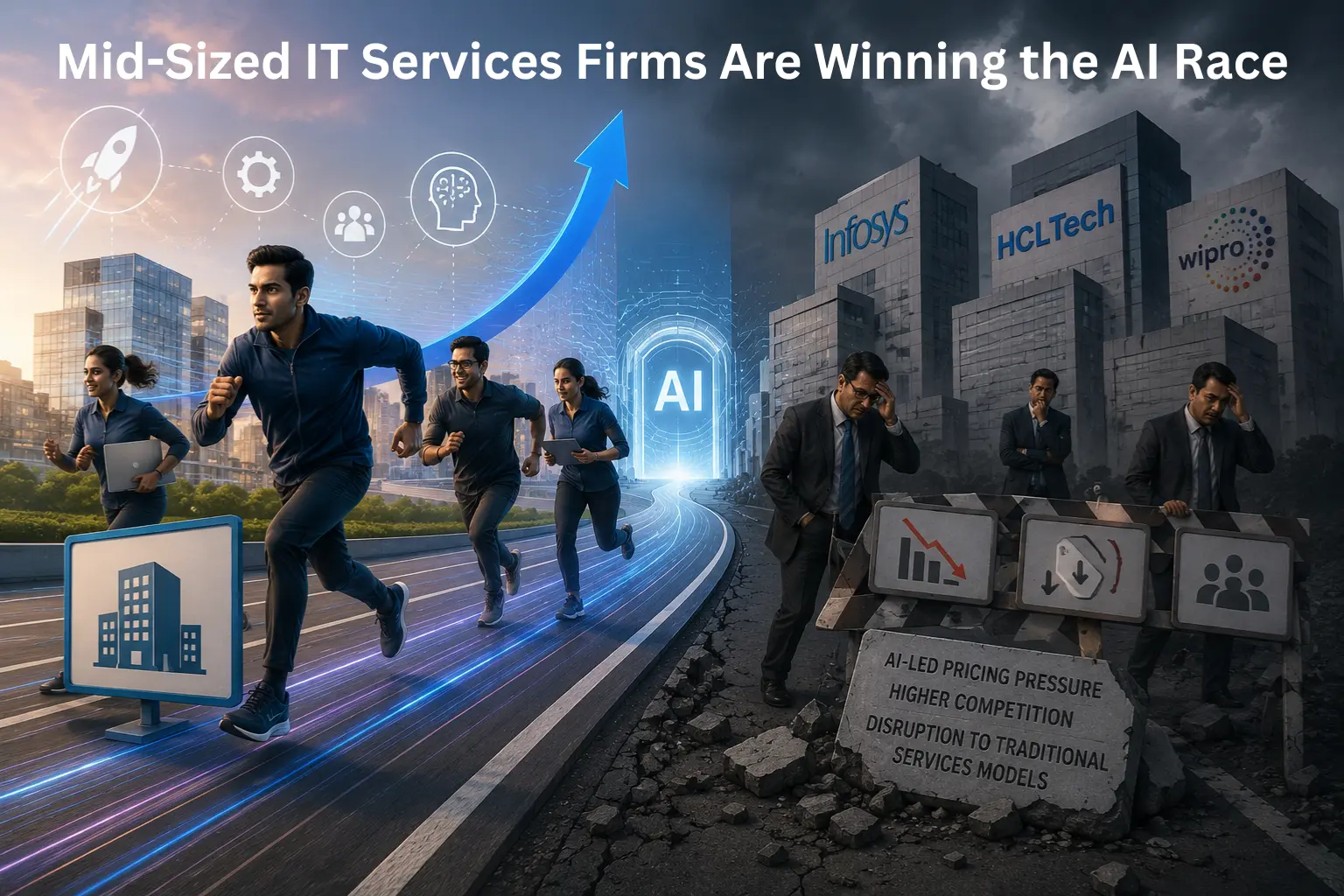
The global IT services industry is going through one of its biggest transformations in decades. Artificial Intelligence (AI) is reshaping how businesses operate, how software is developed, and how technology services are delivered. While many expected large IT giants to dominate this transition, the reality in 2026 is turning out differently.
Mid-sized IT services companies are emerging as strong competitors in the AI-driven market. According to reports highlighted by Mint, firms like Coforge and Persistent Systems are showing stronger confidence and faster growth compared to several Tier 1 IT companies.
Meanwhile, large players such as Infosys, HCLTech, and Wipro have openly discussed concerns about AI-led pricing pressure, increasing competition, and disruption to traditional outsourcing models.
This shift is creating a new era in the IT industry where agility, specialization, and speed matter more than size alone.
The AI Revolution Is Changing the IT Services Industry
Artificial Intelligence is no longer an experimental technology. Businesses across industries are actively investing in:
- AI automation
- Machine learning solutions
- Generative AI applications
- AI-powered customer support
- Intelligent data analytics
- Cloud modernization
- Workflow automation
Companies now want faster implementation, measurable results, and lower operational costs. This demand is putting pressure on traditional IT service providers that relied heavily on large-scale manpower-based outsourcing models.
Earlier, bigger companies had an advantage because of:
- Large workforce
- Global delivery centers
- Massive client portfolios
- Enterprise relationships
However, AI is reducing dependency on manual processes. Automation can now complete tasks that previously required large teams. As a result, enterprises are increasingly looking for technology partners that can innovate quickly rather than simply provide scale.
This is where mid-sized IT firms are gaining momentum.
Why Mid-Sized IT Firms Are Performing Better
1. Faster Decision-Making
Mid-sized IT companies usually have leaner management structures. This allows them to:
- Approve projects faster
- Adapt to market changes quickly
- Launch AI solutions rapidly
- Experiment with emerging technologies
Large enterprises often struggle with multiple approval layers and slower execution cycles. In contrast, smaller firms can pivot faster based on customer requirements.
This agility has become a major competitive advantage in the AI era.
2. Strong Domain Expertise
Many mid-sized IT firms focus deeply on specific industries such as:
- Banking
- Healthcare
- Insurance
- Retail
- Manufacturing
- Travel technology
Instead of offering generic IT services, they provide specialized AI-driven solutions tailored to industry problems.
For example, companies can now build:
- AI-powered fraud detection systems for banks
- Predictive healthcare analytics
- Retail recommendation engines
- Automated customer service platforms
This niche expertise helps mid-sized firms create higher business value for clients.
3. Better Client Relationships
Mid-tier firms often provide more personalized service compared to large corporations. Clients frequently report benefits such as:
- Faster communication
- Dedicated teams
- Flexible pricing models
- Customized AI implementation strategies
In the AI transformation journey, enterprises want collaborative partners rather than rigid vendors. Mid-sized firms are successfully positioning themselves as innovation partners.
4. AI Adoption Is Easier for Smaller Organizations
Large IT companies have legacy systems, huge employee bases, and traditional revenue models. Transitioning these structures to AI-driven operations can be slow and expensive.
Mid-sized firms have fewer operational complexities, allowing them to:
- Integrate AI tools faster
- Train employees quickly
- Redesign workflows efficiently
- Automate internal operations rapidly
This gives them a stronger ability to respond to changing market demands.
Revenue Growth Shows the Difference
Reports suggest that companies like Coforge and Persistent Systems have demonstrated stronger revenue growth compared to many large IT firms.
The reason behind this growth includes:
- Higher AI project demand
- Increased digital transformation spending
- Strong cloud service integration
- Faster project delivery
- Specialized enterprise solutions
Many enterprises now prefer smaller, focused partners that can deliver rapid innovation rather than massive long-term outsourcing contracts.
This marks a major change in how businesses choose IT service providers.
Challenges Faced by Large IT Companies
Large IT firms are still industry leaders, but they are facing increasing pressure in the AI era.
AI-Led Pricing Pressure
AI automation reduces the need for manual coding and repetitive tasks. This directly impacts the traditional billing models used by large IT companies.
Earlier, companies charged clients based on:
- Number of employees
- Project duration
- Resource allocation
Now, AI tools can complete the same tasks much faster with smaller teams. Clients expect lower pricing and faster results.
This creates revenue pressure for traditional outsourcing giants.
Disruption to Legacy Business Models
Many Tier 1 IT firms built their success around labor-intensive service delivery models. AI is fundamentally changing that structure.
Businesses now want:
- Outcome-based pricing
- Automation-first solutions
- AI-driven efficiency
- Low-cost digital transformation
Traditional service models are becoming less attractive in the modern market.
Rising Competition
The AI market has lowered entry barriers for technology companies. Smaller firms can now compete globally by leveraging advanced AI tools and cloud platforms.
This means large IT companies are no longer competing only with each other. They are also competing with:
- AI startups
- Cloud-native companies
- Specialized technology firms
- Mid-sized agile service providers
The competitive landscape is becoming more crowded than ever.
Enterprises Want Faster AI Transformation
Modern businesses are under pressure to innovate quickly. Companies across industries are racing to implement AI because they want to:
- Reduce operational costs
- Improve customer experience
- Increase efficiency
- Automate workflows
- Gain competitive advantage
As a result, enterprises prefer IT partners that can move fast and deliver immediate impact.
Mid-sized firms are increasingly becoming the preferred choice because they can:
- Build prototypes quickly
- Deploy AI systems faster
- Customize solutions easily
- Offer flexible engagement models
Speed has become one of the biggest success factors in the AI economy.
The Future of the IT Services Industry
The rise of mid-sized IT companies does not mean large firms will disappear. Instead, the industry is entering a phase where:
- Agility matters more
- AI capabilities define growth
- Specialized expertise becomes critical
- Innovation drives client acquisition
Large IT firms still possess strong global infrastructure, massive enterprise relationships, and financial power. However, they now need to evolve faster to stay competitive.
Experts believe future success will depend on:
- AI integration capabilities
- Workforce reskilling
- Automation strategies
- Innovation speed
- Customer-centric transformation
Companies that fail to adapt may struggle in the coming years.
How AI Is Reshaping IT Jobs
The AI transformation is also changing the workforce structure inside IT companies.
Growing Demand for AI Skills
Businesses are increasingly hiring professionals skilled in:
- Machine learning
- Data science
- Cloud computing
- Generative AI
- Cybersecurity
- AI automation tools
Traditional coding roles are evolving into more strategic and AI-assisted functions.
Reskilling Is Becoming Essential
Both large and mid-sized IT companies are investing heavily in employee training programs.
Professionals now need to learn:
- AI tools
- Prompt engineering
- Cloud platforms
- Automation frameworks
- Advanced analytics
The future IT workforce will require continuous learning to stay relevant.
Conclusion
The AI revolution is creating a major shift in the global IT services industry. While large IT giants continue to hold strong market positions, mid-sized firms are rapidly gaining attention because of their agility, faster execution, and specialized expertise.
Companies like Coforge and Persistent Systems are proving that innovation and adaptability can outperform scale in the AI era.
At the same time, major firms such as Infosys, HCLTech, and Wipro are facing increasing pressure to modernize traditional business models.
As enterprises continue searching for faster AI transformation partners, the competition between large and mid-sized IT companies will become even more intense.
One thing is clear in 2026, success in the IT services industry is no longer defined only by size. It is defined by speed, innovation, AI capability, and the ability to adapt to a rapidly changing digital world.