

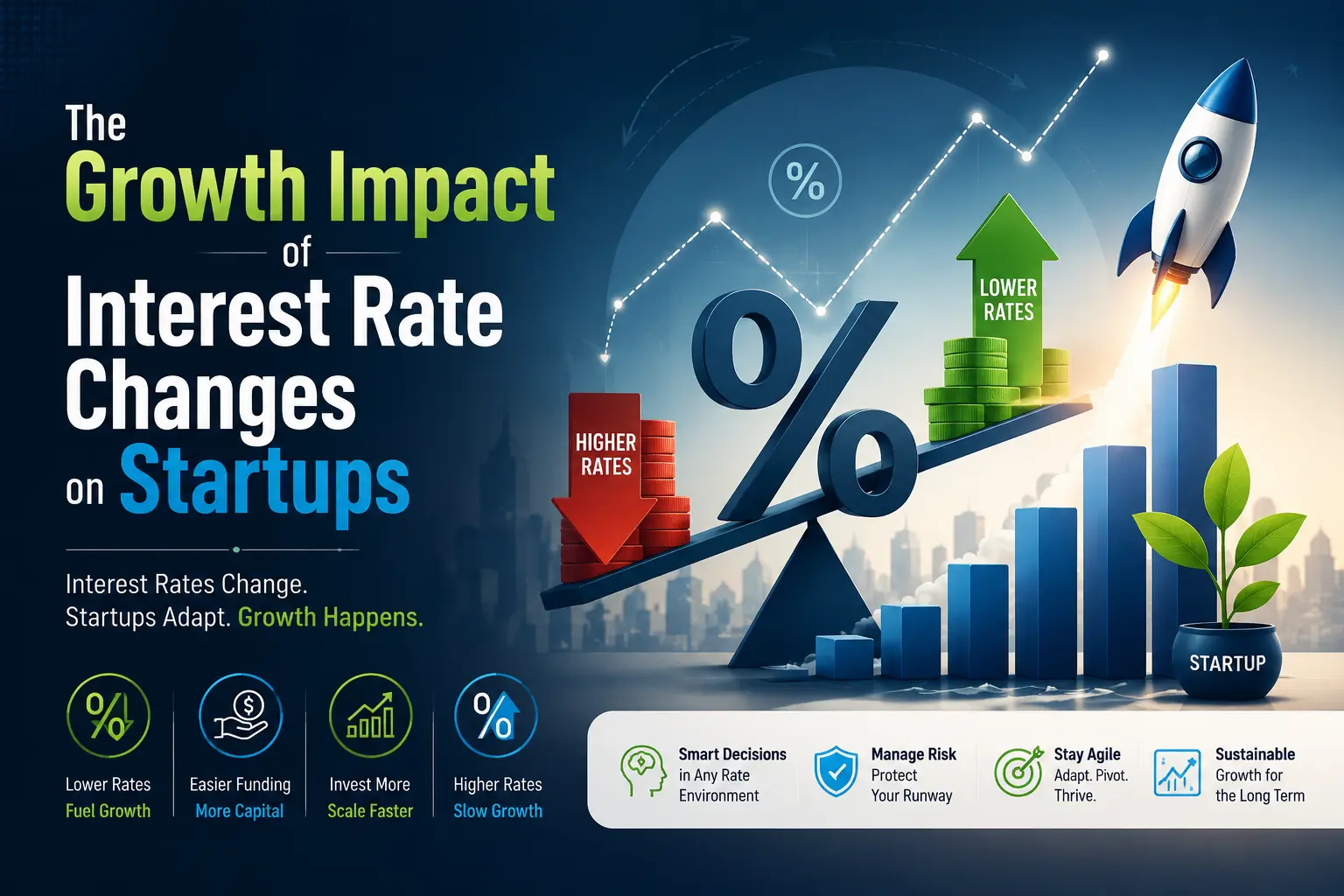
Growth Impact of Interest Rate Changes on Startups
Interest rates play a major role in shaping the startup economy. While entrepreneurs often focus on product development, customer acquisition, and innovation, the broader economic environment can significantly influence growth opportunities.
Over the past few years, central banks worldwide have adjusted interest rates to control inflation and stabilize economies. These decisions have had a direct impact on startup funding, investor behavior, hiring plans, valuations, and overall business growth.
For startup founders, marketers, investors, and business leaders, understanding the relationship between interest rates and startups has become essential. A change of even a few percentage points can influence access to capital, expansion strategies, and long-term sustainability.
This article examines how interest rate changes affect startups, explores current market trends, and provides practical insights for navigating today’s funding climate.
Understanding Interest Rates and Their Economic Role
Interest rates represent the cost of borrowing money. Central banks such as the Federal Reserve in the United States, the European Central Bank, and the Reserve Bank of India use interest rates as a tool to manage inflation and economic growth.
When interest rates rise:
- Borrowing becomes more expensive.
- Consumer spending often slows.
- Investors become more cautious.
- Startup funding may become harder to secure.
When interest rates fall:
- Borrowing becomes cheaper.
- Investment activity tends to increase.
- Venture capital funding often expands.
- Business growth accelerates.
For startups that rely heavily on external funding, these changes can have significant consequences.
Why Interest Rates Matter for Startups
Unlike established corporations with stable cash flows, startups often depend on venture capital, angel investors, loans, or credit facilities to fund growth.
Higher interest rates can impact startups through:
Reduced Venture Capital Activity
Investors compare startup investments with lower-risk alternatives such as bonds and fixed-income securities.
As interest rates rise:
- Bond yields become more attractive.
- Risk appetite decreases.
- Venture capital firms become more selective.
This often leads to fewer funding rounds and lower startup valuations.
Increased Cost of Capital
Many startups use:
- Business loans
- Credit lines
- Equipment financing
- Venture debt
Higher interest rates increase financing costs, reducing available cash for expansion and innovation.
Lower Consumer Spending
When consumers face higher borrowing costs, discretionary spending often declines.
This particularly affects:
- E-commerce startups
- Consumer technology companies
- Subscription-based businesses
- Fintech platforms
Reduced customer spending can slow revenue growth.
Current Funding Climate: What the Data Shows
The startup ecosystem experienced significant changes following global interest rate hikes.
According to industry reports from major venture capital trackers:
- Global venture funding declined sharply from record highs achieved during the low-interest-rate environment of 2021.
- Investors shifted focus from growth-at-all-costs strategies toward profitability.
- Late-stage startup valuations faced significant downward pressure.
- Early-stage startups remained relatively resilient but faced tougher due diligence processes.
Several market studies indicate that venture capital investment remains below peak levels despite gradual stabilization in some sectors.
Artificial intelligence startups remain a notable exception, attracting substantial capital due to strong growth potential and technological innovation.
Interest Rates and Startup Funding: A Comparison
| Factor | Low Interest Rate Environment | High Interest Rate Environment |
| Venture Capital Availability | High | Lower |
| Startup Valuations | Higher | Lower |
| Investor Risk Appetite | Strong | Cautious |
| Business Loans | Affordable | Expensive |
| Growth Spending | Aggressive | Controlled |
| Hiring Activity | Rapid | Selective |
| Exit Opportunities | More Frequent | Reduced |
This comparison highlights how monetary policy influences the startup ecosystem.
Impact on Different Startup Sectors
Not all startups experience interest rate changes equally.
Technology Startups
Technology startups often rely heavily on external funding.
Higher rates can result in:
- Longer fundraising cycles
- Reduced valuations
- Increased pressure to demonstrate profitability
However, AI and enterprise software companies continue attracting strong investor interest.
Fintech Startups
Fintech companies face a unique situation.
Higher rates can:
- Increase lending revenues
- Improve savings product margins
- Create opportunities in financial management tools
At the same time, loan default risks may increase.
E-Commerce Businesses
Consumer-focused startups often face challenges during periods of rising interest rates because household spending tends to decline.
Common impacts include:
- Lower conversion rates
- Reduced average order values
- Increased customer acquisition costs
SaaS Companies
Software-as-a-Service businesses are generally more resilient due to recurring revenue models.
Investors increasingly favor SaaS startups that demonstrate:
- Strong retention rates
- Positive cash flow
- Sustainable growth
Real-World Examples of Startup Adaptation
Focus on Profitability
Many startups that once prioritized rapid expansion have shifted toward operational efficiency.
Companies have:
- Reduced marketing spend
- Optimized hiring
- Extended cash runway
- Improved unit economics
AI Sector Growth
Despite tighter funding conditions, AI startups continue attracting significant investment.
Investors view artificial intelligence as a long-term growth opportunity capable of delivering transformational business value across industries.
Venture Debt Caution
Several startups previously relied on venture debt during low-rate periods.
As borrowing costs increased, founders became more cautious about leveraging debt for growth.
How Founders Can Navigate a High Interest Rate Environment
1. Strengthen Cash Flow Management
Cash preservation becomes critical when capital is harder to access.
Founders should:
- Monitor burn rate closely
- Improve receivables collection
- Reduce unnecessary expenses
2. Focus on Sustainable Growth
Investors increasingly prioritize efficiency over aggressive expansion.
Key metrics include:
- Customer acquisition cost (CAC)
- Lifetime value (LTV)
- Gross margins
- Net revenue retention
3. Diversify Funding Sources
Instead of relying solely on venture capital, startups can explore:
- Strategic partnerships
- Revenue-based financing
- Government grants
- Corporate investment programs
4. Build Investor Confidence
Investors seek evidence of resilience.
Founders should present:
- Clear financial forecasts
- Realistic growth targets
- Strong customer demand
- Defined profitability pathways
5. Invest in Automation
Automation and AI tools help startups improve productivity while controlling costs.
This approach allows businesses to scale without proportionally increasing expenses.
Emerging Trends in the Startup Economy
Several trends are reshaping startup growth strategies.
Greater Focus on Profitability
The era of unlimited capital appears to have faded.
Investors now prioritize:
- Sustainable revenue
- Cash flow discipline
- Operational efficiency
Increased Corporate Investment
Large enterprises are investing in innovative startups to accelerate digital transformation.
This trend provides alternative funding opportunities.
AI-Driven Startup Growth
Artificial intelligence continues attracting investor attention.
AI-powered startups are securing funding across:
- Healthcare
- Marketing
- Finance
- Manufacturing
- Customer service
Selective Venture Capital Deployment
Venture capital firms remain active but conduct deeper due diligence before investing.
Quality has become more important than growth speed.
Key Takeaways for Business Leaders
Important insights include:
- Interest rates directly affect startup funding availability.
- Higher rates typically reduce investor risk appetite.
- Business growth strategies must emphasize efficiency.
- Strong cash management improves survival and scalability.
- AI-focused startups continue attracting substantial investment.
- Sustainable business models are becoming more valuable than rapid expansion.
Companies that adapt quickly to changing economic conditions often emerge stronger than competitors.
Future Outlook: What Happens Next?
Economists expect central banks to remain cautious regarding future interest rate decisions as inflation pressures continue to evolve.
If rates gradually decline:
- Venture capital activity could recover.
- Startup valuations may improve.
- Expansion plans may accelerate.
- Funding markets could become more competitive.
However, investors are unlikely to return fully to the aggressive funding practices seen during the ultra-low-interest-rate era.
The future startup economy will likely reward businesses that combine innovation with financial discipline.
Founders who build efficient operations, demonstrate market demand, and maintain strong cash flow management will remain attractive to investors regardless of economic conditions.
FAQs
1. How do interest rates affect startups?
Interest rates influence borrowing costs, investor behavior, startup valuations, and funding availability. Higher rates generally make raising capital more difficult.
2. Why do venture capital investments decline when interest rates rise?
Higher interest rates provide investors with safer investment alternatives that offer better returns, reducing the appeal of high-risk startup investments.
3. Which startup sectors perform best during high-interest-rate periods?
Enterprise software, AI, cybersecurity, and some fintech businesses often perform better because they provide essential services and strong revenue potential.
4. Can startups still raise funding when interest rates are high?
Yes. Startups with strong business models, clear revenue growth, and a path to profitability continue attracting investors.
5. What should founders prioritize during a challenging funding climate?
Founders should focus on cash flow management, profitability, customer retention, operational efficiency, and diversified funding strategies.
Conclusion
Interest rates and startups are closely connected. Changes in monetary policy affect funding access, investor confidence, valuations, and overall business growth. While rising rates create challenges, they also encourage stronger financial discipline and more sustainable business models.
The startups most likely to succeed are those that balance innovation with operational efficiency. As the funding climate evolves, founders who focus on profitability, customer value, and smart capital allocation will be better positioned for long-term success.
Want more insights on business trends, startup funding, technology, and the global economy? Explore our latest articles and stay informed about the forces shaping tomorrow’s business landscape.