

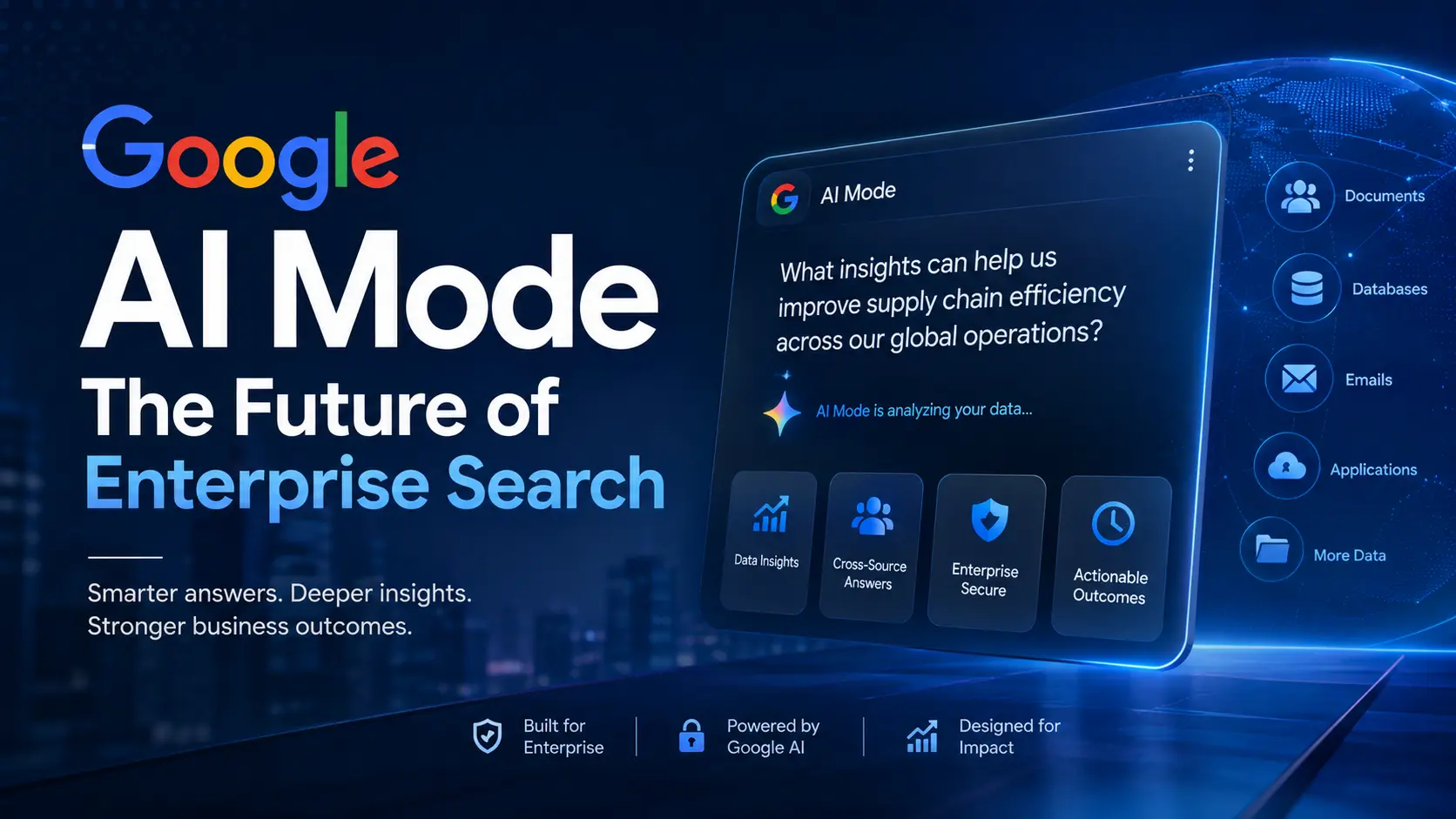
Google Search is entering a new phase. Instead of returning only a list of links, it is becoming an intelligent assistant capable of understanding context, summarizing information, comparing options, and answering complex business questions.
This shift is powered by Google AI Mode, Google’s next-generation search experience built on advanced generative AI models. For founders, enterprise leaders, marketers, and technology teams, this is more than another product update. It changes how customers discover information, evaluate brands, and make purchasing decisions.
Enterprise search is also evolving. Organizations now expect AI-powered systems that retrieve accurate information across documents, emails, knowledge bases, CRMs, and cloud applications in seconds. Companies that adapt their AI search strategy early will gain an advantage in productivity, customer experience, and digital visibility.
India, one of the world’s fastest-growing digital economies, is expected to play a significant role in this transformation. With rapid AI adoption, expanding startup ecosystems, and government-backed digital initiatives, Indian enterprises are well-positioned to benefit from AI-powered search technologies.
What Is Google AI Mode?
Google AI Mode is an advanced search experience that combines traditional search with generative AI.
Instead of displaying only blue links, AI Mode analyzes multiple sources, understands user intent, and generates comprehensive responses while offering supporting links for deeper exploration.
Unlike conventional search, AI Mode handles complex, multi-step questions such as:
“Which CRM platform offers the best AI features for mid-sized manufacturing companies with under 500 employees?”
Instead of forcing users to compare multiple websites manually, Google AI Mode provides:
- Structured summaries
- Feature comparisons
- Follow-up questions
- Personalized recommendations
- Context-aware answers
This makes search more conversational and significantly faster.
Why Enterprise Search Is Changing
Traditional enterprise search often struggles with fragmented data.
Organizations store information across:
- Google Workspace
- Microsoft 365
- Slack
- Salesforce
- SharePoint
- Internal databases
- Customer support platforms
Employees waste valuable time searching for documents and company knowledge.
According to multiple workplace productivity studies, knowledge workers spend several hours each week searching for information instead of completing meaningful work.
Modern enterprise search powered by AI solves this challenge by:
- Understanding natural language
- Connecting multiple data sources
- Ranking answers instead of files
- Learning from user behavior
- Providing summarized insights
The result is faster decision-making and improved productivity.
Google AI Mode vs Traditional Search
| Feature | Traditional Search | Google AI Mode |
| Search Results | List of links | AI-generated answers with sources |
| Context Understanding | Limited | Advanced |
| Multi-step Questions | Difficult | Excellent |
| Personalized Responses | Low | High |
| Follow-up Conversations | No | Yes |
| Business Research | Manual | AI-assisted |
| Information Summary | User-created | AI-generated |
For enterprises, this reduces research time while improving information quality.
Why Google AI Mode Matters for Businesses
Google AI Mode affects every stage of the customer journey.
Potential buyers no longer search using only short keywords.
Instead, they ask questions like:
- Which cybersecurity platform is best for healthcare?
- What is the most affordable ERP software for manufacturers?
- Compare leading HRMS platforms for startups.
Businesses that publish helpful, authoritative content are more likely to become trusted sources in AI-generated search experiences.
This makes content quality more important than content quantity.
Enterprise Search Is Becoming an AI Assistant
Enterprise search is no longer just document retrieval.
Modern AI-powered systems perform tasks like:
- Summarizing lengthy reports
- Finding company policies
- Comparing contracts
- Drafting emails
- Generating meeting summaries
- Recommending internal experts
- Answering employee questions instantly
For large organizations, this reduces operational costs while improving employee productivity.
Many enterprises now view AI search as a core digital transformation investment rather than an optional feature.
Building an Effective AI Search Strategy
Businesses need to rethink SEO and content marketing.
An effective AI Search Strategy includes four major pillars.
1. Create Experience-Based Content
Google increasingly rewards content written by experts with real-world knowledge.
Include:
- Case studies
- Original research
- Customer success stories
- Industry insights
- Practical implementation guides
Generic content is becoming less competitive.
2. Build Topical Authority
Instead of writing isolated articles, develop comprehensive content clusters.
Example:
Main Topic:
Google AI Mode
Supporting Articles:
- AI Search Strategy
- Enterprise Search Platforms
- AI Marketing Workflow
- AI SEO Best Practices
- Generative AI in Business
This helps search engines understand your expertise.
3. Focus on User Intent
Modern search prioritizes intent over exact keywords.
Rather than targeting:
“Enterprise Search”
Create content answering:
- How do enterprises implement AI search?
- Which enterprise search platform is best?
- How much does AI enterprise search cost?
- What are enterprise search challenges?
4. Improve Technical SEO
Technical optimization remains essential.
Prioritize:
- Fast page speed
- Mobile-first design
- Structured data
- Clean site architecture
- Internal linking
- HTTPS security
- Core Web Vitals optimization
AI-generated answers still rely on high-quality indexed websites.
AI Marketing Workflow Is Changing
Marketing teams are already integrating AI into daily operations.
An effective AI Marketing Workflow includes:
- Market research using AI
- Content planning
- Keyword clustering
- Content generation with human review
- SEO optimization
- Performance monitoring
- Continuous content updates
The winning approach is not replacing marketers with AI.
It is combining AI efficiency with human expertise.
Editorial oversight remains critical for maintaining trust and accuracy.
Real-World Enterprise Applications
Several industries are already benefiting from AI-powered search.
Healthcare
Doctors quickly retrieve clinical guidelines, patient documentation, and research papers.
Banking
Financial institutions improve compliance searches across regulations and internal policies.
Manufacturing
Engineers locate maintenance procedures, equipment manuals, and operational knowledge.
Retail
Customer support teams instantly access product information and order policies.
IT Services
Developers search internal documentation, APIs, and coding standards using conversational queries.
India’s AI Opportunity
India is emerging as one of the world’s largest AI adoption markets.
Several factors are accelerating growth:
- Expanding startup ecosystem
- Rapid cloud adoption
- Strong software engineering talent
- Government initiatives supporting AI innovation
- Growing investment in digital infrastructure
Large Indian enterprises across banking, healthcare, manufacturing, education, and retail are increasingly deploying AI-powered search to improve operational efficiency.
Indian startups are also building AI-first products that integrate enterprise search with customer service, HR, finance, and workflow automation.
As AI infrastructure becomes more affordable, even mid-sized businesses are expected to adopt intelligent enterprise search solutions.
This creates opportunities for software providers, digital marketers, and technology consultants.
Challenges Businesses Should Prepare For
AI-powered search also introduces new responsibilities.
Organizations should address:
- Data privacy
- AI hallucinations
- Information accuracy
- Copyright compliance
- Security permissions
- Responsible AI governance
Human validation remains essential for high-value business decisions.
Companies should establish clear AI usage policies and regularly audit AI-generated outputs.
Actionable Recommendations for Business Leaders
If your organization wants to stay competitive, consider these priorities:
- Audit your existing content library.
- Build topical authority instead of publishing isolated blogs.
- Invest in structured knowledge management.
- Develop an enterprise-wide AI Search Strategy.
- Train employees to use AI responsibly.
- Optimize technical SEO for AI-driven search.
- Publish original research and industry insights.
- Measure AI search visibility alongside traditional SEO metrics.
Organizations that combine trusted expertise with AI-powered workflows will be better positioned for long-term growth.
Key Takeaways
- Google AI Mode is transforming how users search for information.
- Enterprise search is shifting from document retrieval to intelligent knowledge assistance.
- High-quality, expert-led content is becoming the foundation of AI visibility.
- AI Marketing Workflow improves productivity when paired with human oversight.
- India is well-positioned to become a global leader in enterprise AI adoption.
- Businesses that invest in AI Search Strategy today are likely to gain a competitive advantage as search continues to evolve.
FAQs
1. What is Google AI Mode?
Google AI Mode is an AI-powered search experience that generates conversational answers, summarizes information from multiple sources, and supports follow-up questions while linking to trusted websites.
2. How does Google AI Mode affect SEO?
SEO shifts toward creating authoritative, experience-driven content that answers user intent. Strong technical SEO, topical authority, and trustworthy information become even more important.
3. What is enterprise search?
Enterprise search enables employees to search and retrieve information across internal systems such as documents, emails, cloud storage, CRM platforms, and knowledge bases using a single interface.
4. What is an AI Search Strategy?
An AI Search Strategy combines content quality, technical SEO, structured data, topical authority, and AI-ready knowledge management to improve visibility in AI-powered search experiences.
5. How can businesses improve their AI Marketing Workflow?
Businesses should integrate AI into research, content planning, SEO optimization, analytics, and campaign reporting while maintaining human review to ensure quality, compliance, and brand consistency.
Conclusion
Google AI Mode represents one of the most significant changes to search since the introduction of mobile-first indexing. As AI-generated answers become central to how people find and evaluate information, enterprises must rethink both internal knowledge management and external digital marketing.
Success will depend on producing original, trustworthy content, strengthening technical SEO, and building a sustainable AI Search Strategy that aligns with evolving user behavior. At the same time, enterprise search will continue to evolve into an intelligent business assistant, helping organizations unlock productivity, improve decision-making, and deliver better customer experiences.
For Indian enterprises, startups, and technology leaders, this shift offers an opportunity to lead rather than follow. Companies that invest in AI-ready content, modern search infrastructure, and responsible AI adoption today will be better prepared for the next generation of digital growth.